
At BYoung Physical Therapy, we often see athletes who view their post-operative journey as a simple countdown on a calendar. However, the true recovery time for Tommy John surgery isn’t just about waiting for the ulnar collateral ligament (UCL) graft to heal; it’s about rebuilding the athlete from the ground up.
What is a UCL Tear?
The UCL is a small but critical band of tissue on the inner side of the elbow. Its primary job is to provide stability against valgus stress—the force that tries to pull the elbow joint apart during the late cocking and early acceleration phases of a throw. When this stress becomes repetitive or excessive, the ligament can fray or rupture completely.
What is Tommy John Surgery?
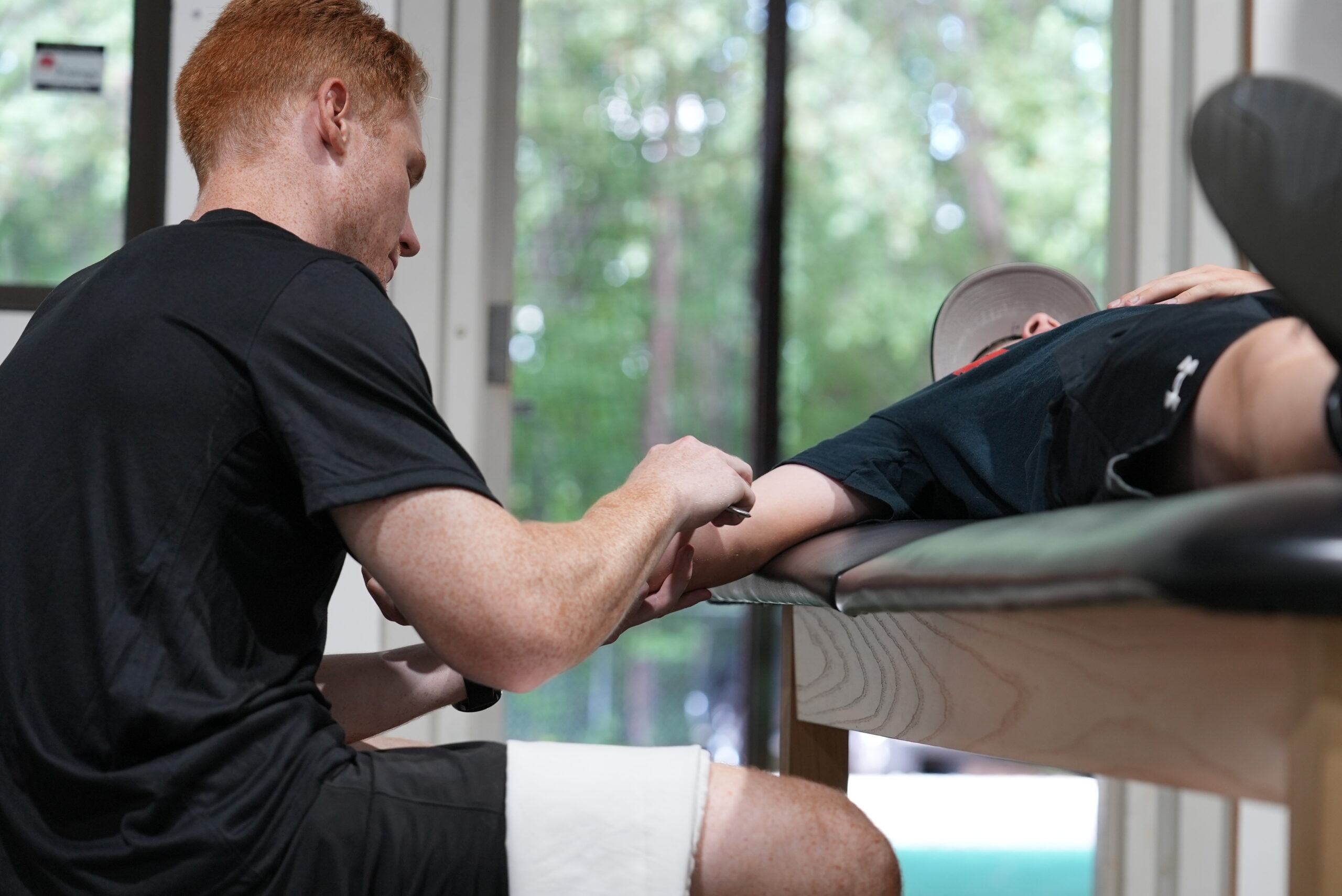 Named after the MLB pitcher who first underwent the procedure in 1974, Tommy John surgery is clinically known as UCL reconstruction. During the procedure, an orthopedic surgeon replaces the torn ligament with a tendon graft taken from elsewhere in the patient’s body (like the wrist or hamstring) or from a donor. The surgeon drills tunnels into the humerus (upper arm bone) and ulna (forearm bone) to secure the new graft in a figure-eight pattern.
Because this graft must undergo a biological process called ligamentization—where the transplanted tendon slowly transforms into a functional ligament—the recovery time for Tommy John surgery is inherently long. This biological clock cannot be fast-forwarded; it requires patience and a strategic approach to rehabilitation.
The Kinetic Chain: Your Secret to a Safer Return
When a pitcher sustains a UCL tear, the elbow is often the victim, not the culprit. The elbow experiences tremendous valgus torque during the late cocking phase of pitching—often exceeding the failure strength of the ligament itself. To protect the new graft, we must address why the original injury occurred.
The kinetic chain describes how energy is transferred from the legs, through the core, and out to the fingertips. If there is a leak in this chain—such as limited hip mobility or poor thoracic spine rotation—the arm must overcompensate to maintain ball velocity. This mechanical inefficiency is a primary reason why the recovery time for Tommy John surgery must be milestone-based, not just time-based.
Key Biomechanical Pillars We Address
Hip and Pelvis Mobility
The gluteus maximus initiates the throwing motion. A lack of lead-leg stability or trail-leg hip internal rotation forces the upper body to rush, placing late, aggressive stress on the medial elbow.
Thoracic Spine Rotation
The thoracic spine (mid-back) is designed to rotate. If it is stiff, the body often steals that motion from the lower back or the shoulder, indirectly increasing the tension on the UCL graft.
Scapular Stability
Your shoulder blade is the foundation for your arm. Proper scapular positioning ensures that the rotator cuff can effectively shield the elbow from excessive force.
Why Your Recovery Timeline May Vary
While the standard recovery time for Tommy John surgery is often quoted as 12 to 18 months for pitchers, returning to peak performance often takes closer to 20 months.
At our clinics, we use specialized video analysis and objective strength testing to ensure you aren’t just cleared by a calendar date. We look for:
- symmetry in hip and shoulder range of motion
- adequate forearm flexor-pronator mass strength (which provides active stability to the UCL)
- clean mechanics during the initial phases of an interval throwing program
If these biomechanical markers are not met, rushing the recovery time for Tommy John surgery significantly increases the risk of graft failure or secondary shoulder issues.
Prioritizing Long-Term Health and Performance
At BYoung Physical Therapy, we believe that a successful outcome isn’t measured by getting you back for the next season, but by ensuring you stay on the field long-term. Short-cutting the recovery time for Tommy John surgery by ignoring total-body deficits is a primary driver of secondary injuries, such as rotator cuff tears or labral issues.
That’s why we implement corrective strategies—ranging from targeted strength work to dry needling for soft tissue management—that optimize your mechanics. Recovery is a strategic, step-by-step process. By prioritizing your unique biomechanics over a generic timeline, we provide the stability and confidence you need to return to the mound stronger than before.
Navigating the recovery time for Tommy John surgery is a marathon, and we are here to ensure every mile is backed by science and strategy. Contact us to schedule an evaluation with our Doctors of Physical Therapy and start your personalized road to recovery.