
 In the world of sports medicine, labral tear recovery is one of the most complex challenges a pitcher can face. While a successful outcome for the general population might be reaching into a cupboard pain-free, success for a pitcher is defined by the ability to withstand the extreme forces required to throw at a high level.
At BYoung Physical Therapy, we focus on the clinical nuances that ensure an athlete doesn’t just return to the field, but excels there. One of the most critical metrics in this process is identifying and treating glenohumeral internal rotation deficit (GIRD).
Understanding the GIRD Phenomenon
Most clinical discussions around pitching focus on layback—the extreme external rotation reached during the late cocking phase. However, for every degree of external rotation gained, there is often a corresponding loss of internal rotation.
GIRD occurs when the throwing shoulder loses significant internal rotation compared to the non-throwing side. Research, including studies published in the American Journal of Sports Medicine, indicates that a deficit of more than 20° (or a loss of total motion) significantly increases the risk of SLAP tears and ulnar collateral ligament (UCL) strain. When internal rotation is restricted, the center of rotation of the humeral head shifts, creating a peel-back mechanism that stresses the labrum during the acceleration phase of the throw.
Clinical Case Study: Jack’s Path to Performance
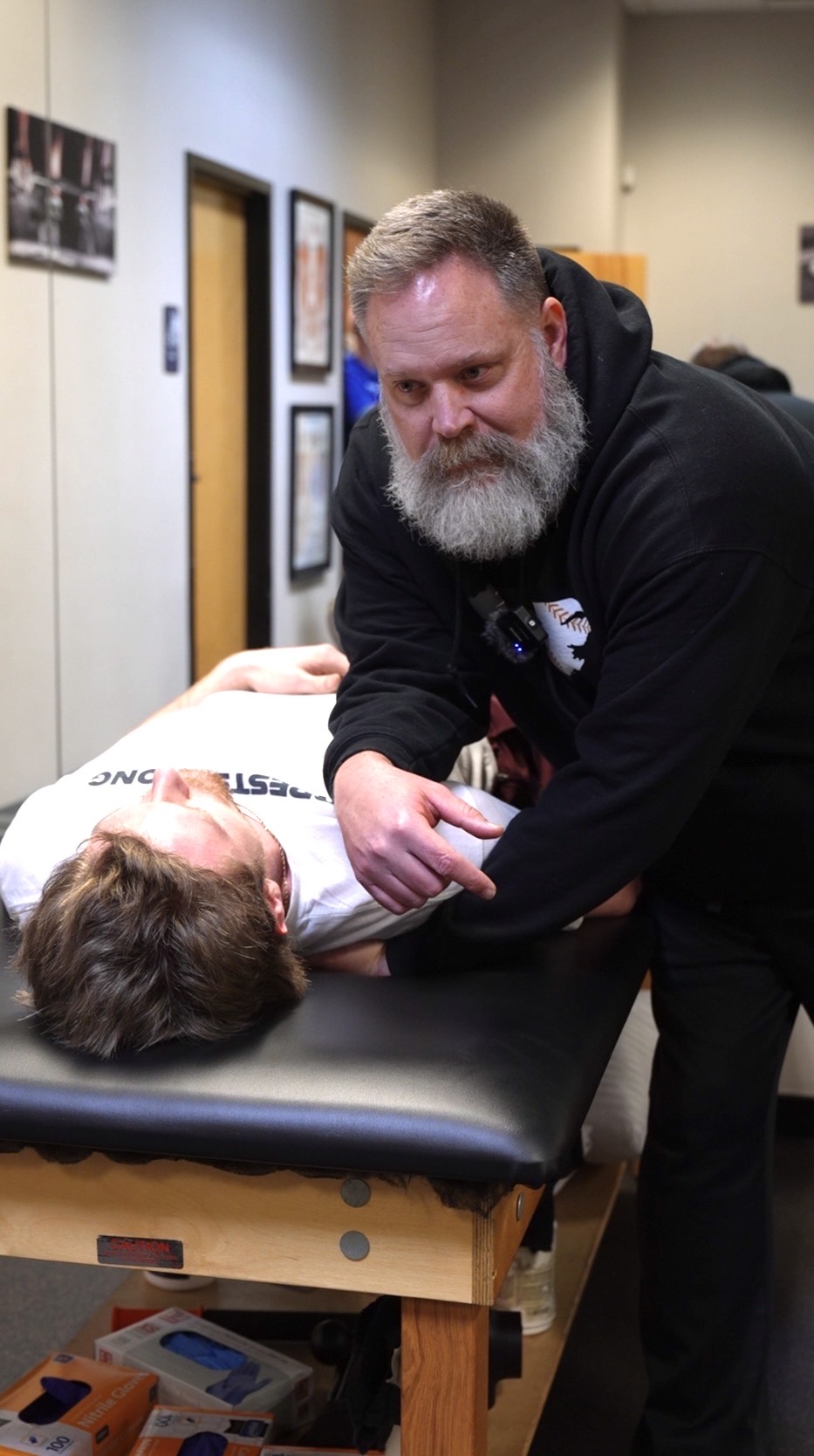
One of our patients, Jack, came to us with a Type 2 SLAP tear. He had previously attempted conservative management, but continued to experience intermittent pain during his outings. After opting for a surgical repair, we began a multi-phase, evidence-based protocol designed to rebuild his shoulder from the ground up, with a heavy emphasis on restoring his posterior capsule mobility.
In week 13, Jack officially reached a pivotal milestone. At this stage, the surgical repair had achieved sufficient biological healing to allow for increased mechanical stress. Our current focus includes:
- Restoring the Total Motion Arc: ensuring his total range (internal rotation + external rotation) is symmetrical to his non-throwing side
- Posterior Capsule Mobilization: utilizing manual therapy and specific stretching to alleviate the stiffness that drives GIRD
- Deceleration Training: strengthening the posterior rotator cuff to manage the high-velocity internal rotation that occurs after the ball is released
Why the Kinetic Chain Matters
A labral tear is rarely an isolated shoulder problem; it is a symptom of how the body moves as a unit. GIRD often forces the body to find range elsewhere, leading to compensations. To get Jack back to the mound, we analyzed more than just the shoulder’s glenohumeral (ball-and-socket) joint:
- Thoracic Spine Mobility: If the mid-back is stiff, the scapula cannot tilt properly, exacerbating the impingement caused by GIRD.
- Scapular Dyskinesis: We ensure the shoulder blade provides a stable foundation. Without scapular control, the humeral head cannot stay centered in the socket.
- Lumbopelvic Control: Power starts in the lower extremity. If a pitcher cannot effectively rotate through their hips, they often over-rotate the shoulder to compensate for the lack of internal rotation.
Strategic Recovery
At BYoung Physical Therapy, we reject one-size-fits-all rehab. We believe labral tear recovery is a strategic, step-by-step process. When navigating a shoulder or elbow injury, your recovery should be as specialized as your position on the field. If you’re ready to bridge the gap between pain-free and game-ready, contact us to schedule an evaluation today.