
 A rotator cuff injury is rarely just about a single tendon; it is a breakdown of the shoulder’s complex centering mechanism. For our patients, rest is often the enemy of progress. When the rotator cuff is compromised, the glenohumeral joint loses its primary stabilizer.
To restore high-level function, we move past generic movement and implement a detailed clinical strategy. By utilizing specific rotator cuff recovery exercises, we don’t just mask the pain; we rebuild the joint’s capacity to handle the extreme torques of sport and daily life.
Phase 1: Establishing the Biological Foundation
Before we can address power and velocity, we must address the biological foundation. The rotator cuff is a complex of four muscles—the supraspinatus, infraspinatus, teres minor, and subscapularis—that work together to stabilize the humerus within the socket. When this system is compromised, the body often compensates by shrugging or using the upper trapezius to lift the arm.
In this initial phase, the priority is protecting the tissue while preventing capsular stiffness. However, a major barrier to this early recovery is scapular dyskinesis—where the shoulder blade hitches or wings because the rotator cuff isn’t providing a stable pivot point. We prioritize restoring proper scapular rhythm (the coordinated movement between your shoulder blade and arm) to ensure the healing tendons aren’t subjected to unnecessary stress.
Codman’s Pendulums
Lean forward and support your upper body with your uninvolved hand on a table. Let your arm hang freely and use your body’s momentum to create small, gentle circles. This promotes circulation and passive mobility without forcing the muscles to contract.
Passive Supine External Rotation
Lie on your back and hold a stick or cane with both hands. Use your unaffected arm to gently push the stick, rotating the involved arm outward while keeping the elbow pinned to your side. This maintains range of motion while respecting the biological healing timeline.
Phase 2: Transitioning to Early Load & Muscle Activation
Once the tissue has gained initial structural integrity, we transition to early loading. The goal is to move the arm using its own musculature, often with light assistance, to wake up the rotator cuff and refine the way the shoulder blade moves.
Side-Lying External Rotation (Neutral)
Lie on your side to remove gravity’s influence on your posture. Place a small towel roll between your elbow and ribs; this acts as a “spacer” that improves blood flow to the tendon and keeps the joint perfectly aligned. Rotate your forearm toward the ceiling, keeping your elbow pinned to the towel. This isolates the infraspinatus and ensures the humerus stays centered in the socket.
Prone Scapular “I” and “T” Variations
Lie face down with your forehead supported. Before lifting your arms, perform a scapular set by squeezing your shoulder blades toward your spine and tucking them down toward your back pockets.
- For the “I”: With palms facing your thighs, lift your straight arms back toward your hips.
- For the “T”: Move your arms out to the side at 90 degrees with your thumbs pointed at the ceiling and lift them toward the sky.
This sequencing ensures the mid and lower trapezius act as an anchor, preventing the common shrugging compensation that leads to neck strain.
Phase 3: Mastering Dynamic Stability & Strength
Once a baseline of mobility and basic activation is established, the focus shifts to neuromuscular control. We teach the rotator cuff muscles to fire efficiently to keep the joint centered during active movement. We prioritize work in the scapular plane—about 30 degrees forward of your side—which is the most natural and least stressful position for the shoulder joint.
Full Can Lateral Raises
Stand with your thumbs pointed up and raise your arms to shoulder height in that 30-degree forward angle. This recruits the supraspinatus while keeping the shoulder in a biomechanically safe position.
Rhythmic Stabilizations
Lie on your back with your arm pointed at the ceiling while a physical therapist applies quick, unpredictable taps to your arm in various directions. Your goal is to keep the arm perfectly still. This is one of the most effective rotator cuff recovery exercises for retraining the reflexive stability needed for catching, throwing, or sudden movements.
Scapular “Y’s”
Lie face down on a bench or stand leaning slightly forward with resistance. Raise your arms at a 45-degree angle to your body so they form a “Y” with your torso. Hold the top position for two seconds, focusing on squeezing the bottom of your shoulder blades together. This builds the posterior strength necessary to support the shoulder complex during high-level loading.
Phase 4: Integrating the Kinetic Chain for Performance
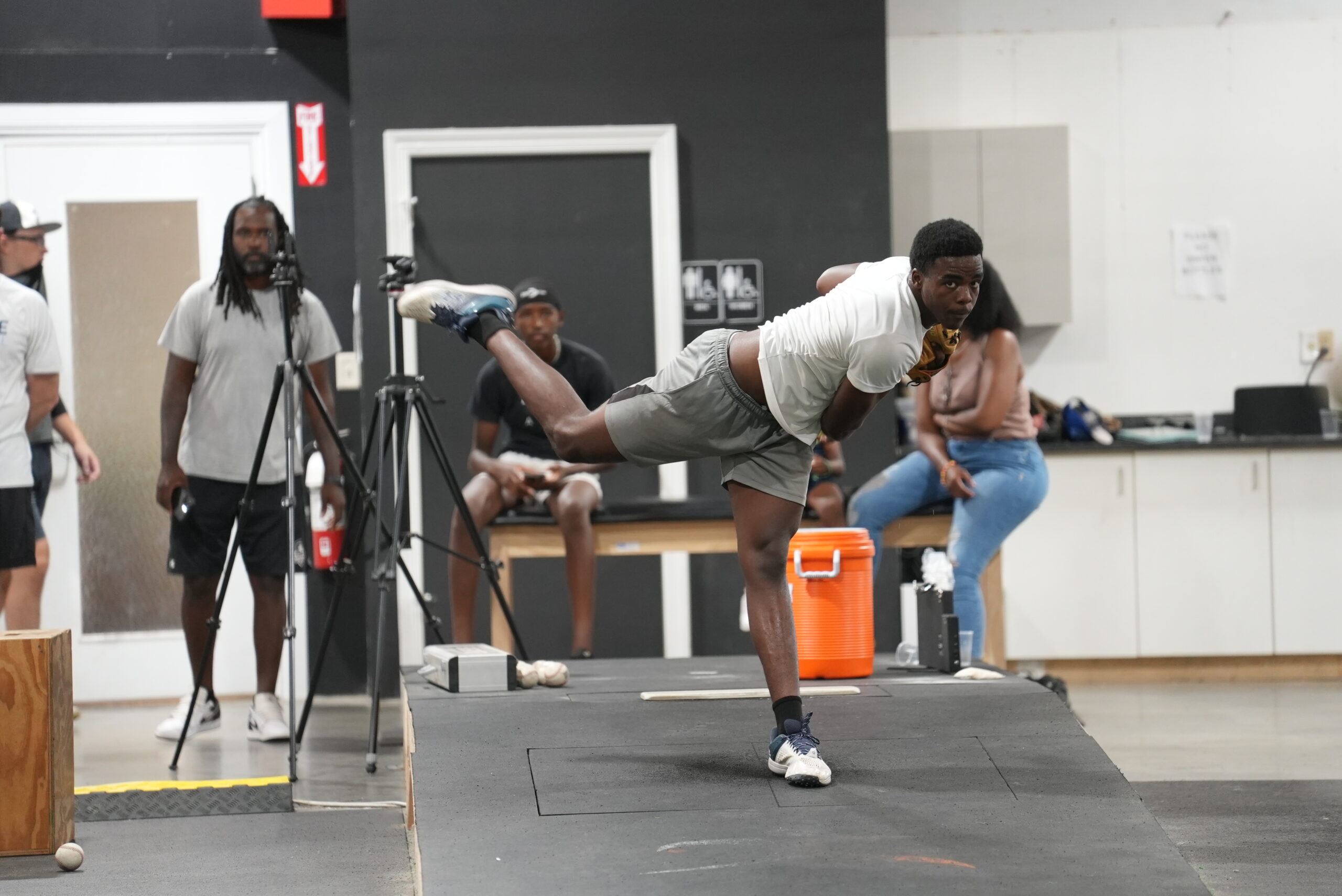
The shoulder does not function in isolation; it is one link in a kinetic chain that starts at the ground. For a pitcher or an overhead athlete, power is generated in the hips and transferred through the core. If there is a leak in this chain, the rotator cuff must work overtime to compensate, leading to secondary strain.
In this final stage, rotator cuff recovery exercises become functional and integrated to ensure your entire body is supporting the joint.
Diagonal “D2” Patterning
Anchor a resistance band at your opposite hip and pull upward and across your body in a “sword draw” motion, rotating your palm until your thumb points behind you at the top. This integrates the rotator cuff with the core, mimicking the movement patterns used in the cocking phase of a throw.
Medicine Ball Deceleration Drills
Face a rebounder or ask a partner/therapist to throw a light medicine ball (1–2 lbs) toward you. Catch the ball and quickly stabilize it to stop the momentum. This rapid deceleration trains the eccentric (lengthening) strength of the posterior cuff, which is the most common site of failure in overhead athletes.
Precision Matters in Your Recovery
Navigating a shoulder injury requires more than a list of movements; it requires a clinical strategy tailored to your unique biomechanics. While generic protocols might offer temporary relief, they rarely address the root mechanical faults that caused the injury in the first place.
Strategic rotator cuff recovery exercises are the cornerstone of a successful return to sport. By prioritizing movement quality and a phased approach to loading, we provide the stability and confidence you need to perform at your peak. Focusing on these advanced rotator cuff recovery exercises ensures that when you return to the mound or the weight room, your shoulder is the strongest link in the chain, not the weakest.
If you are ready to move past shoulder pain and return to the mound, the gym, or the activities you love, contact us to schedule an evaluation with a Doctor of Physical Therapy. Your recovery shouldn’t be left to chance; it should be built on science and strategy.
Clinical Disclaimer: This content is provided for general educational purposes and is not a substitute for a formal physical therapy evaluation, medical diagnosis, or individualized treatment plan. Because every injury is unique, these exercises may not be suitable for every individual or condition. If you experience pain, tingling, numbness, or a worsening of symptoms, stop immediately and consult a licensed physical therapist or healthcare provider. Use of this information is at your own risk.