Returning to the mound after reconstructive elbow surgery is a meticulous process. While many athletes view their rehabilitation as a waiting game, the speed and success of your comeback depends heavily on strategy.
True acceleration in your Tommy John surgery recovery does not mean cutting corners or rushing the biological timeline of the graft. Instead, it means optimizing every variable you can control—from total-body biomechanics to precise load management—so that when the graft is fully healed, your body is ready to perform.
Managing the Biological Clock: How Graft Healing Dictates Progress
 The foundation of Tommy John surgery involves replacing a compromised ulnar collateral ligament (UCL) with a tendon graft. For this tendon to function as a resilient joint stabilizer, it must undergo ligamentization—a biological process where the tissue establishes a new blood supply and restructures its cellular makeup.
Because no major muscles are cut during the procedure, early movement can feel surprisingly easy. However, forcing speed over structure puts the graft at risk. A safe and effective Tommy John surgery recovery aligns clinical progression with this biological clock. Rather than chasing arbitrary calendar dates, acceleration is achieved by systematically applying controlled stress to the tissue, prompting it to adapt and strengthen without triggering an inflammatory setback.
The Total-Body Kinetic Chain: Protecting the Elbow from the Ground Up
The elbow is rarely the sole cause of its own injury. During a high-velocity throw, the medial elbow absorbs immense valgus torque. If the lower body, core, or thoracic spine fail to generate and transfer energy efficiently, the arm must overcompensate to maintain ball velocity.
To accelerate your Tommy John surgery recovery, rehabilitation must look beyond the joint itself.
- Lead-Leg Stability and Hip Mobility: Poor internal rotation in the hips or weak lead-leg control forces the upper body to rush forward, leaving the arm behind and increasing stress on the inner elbow.
- Thoracic Spine Rotation: Restricted mid-back rotation forces the shoulder and elbow to over-rotate to achieve the necessary cocking phase.
- Scapular Control: The shoulder blade acts as the stable foundation for the arm. Proper scapular positioning allows the rotator cuff to actively shield the new UCL graft from excessive torque.
By correcting these total-body mechanical faults while the elbow is healing, you eliminate the original root causes of the injury.
A Criteria-Based Approach to the Phase-by-Phase Timeline
Accelerating your Tommy John surgery recovery relies on passing objective functional criteria rather than relying on time alone.
Phase I: Protection & Early Mobility (Weeks 0–4)
The primary objective is protecting the graft while preventing atrophy in adjacent structures. The arm is initially stabilized in a splint, avoiding any medial joint tension. Meanwhile, active movement of the wrist, fingers, and shoulder keeps neural pathways active. As the incision heals, total-body conditioning begins, preserving your metabolic baseline.
Phase II: Strengthening & Movement Quality (Months 1–4)
The primary objective of Phase II is restoring full, pain-free range of motion across the elbow, forearm, and shoulder.
Once range of motion is restored, light resistance is introduced for elbow flexion, extension, and forearm rotation. Throughout this phase, special emphasis is placed on strengthening the forearm flexor-pronator mass, which provides crucial active protection to the underlying ligament during functional movement.
Phase III: The Interval Throwing Program (Months 4–9)
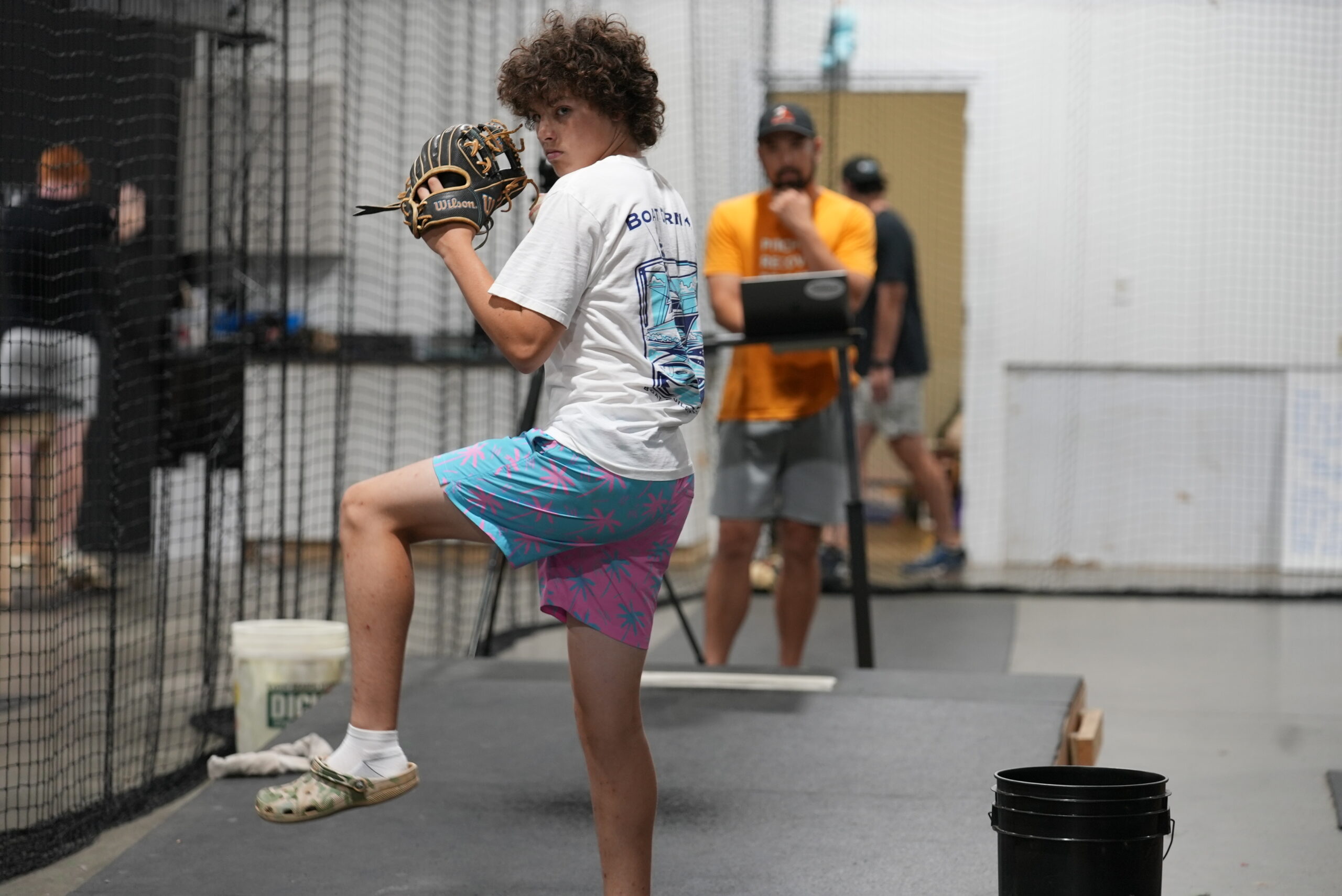
Throwing is a strategic, graded exposure program. Beginning with short, effortless tosses, the protocol systematically builds distance up to 150-foot long-toss routines. This gradual expansion of distance applies functional tension to the graft, rebuilding its elasticity. Transitioning to partial-speed throws from the mound requires strict adherence to proper mechanics: staying over the ball and keeping the elbow elevated to ensure energy transfers smoothly through the entire arm.
Phase IV: High-Intensity Simulation & Return to Competition (Months 9–12+)
The final stage bridges clinical strength and game performance. Athletes utilize “Up/Down” simulations—throwing a designated pitch count, resting for an 8-to-10-minute interval to simulate an inning break, and throwing again. This conditions the reconstructed ligament and surrounding musculature to maintain mechanical integrity under metabolic fatigue.
Rebuilding Confidence for a Long-Term Return
The final hurdle in any Tommy John surgery recovery is psychological. Transitioning from controlled clinic drills to dynamic, full-velocity pitches requires complete trust in your movement patterns. By tracking objective markers—such as rotational power, rotator cuff endurance, and video mechanical analysis—we replace hesitation with measurable proof of readiness.
When every phase of your rehabilitation is executed with intent, you do not simply return to your previous level of play; you return as a more durable, efficient, and powerful athlete.
A Strategic Comeback Built on Science
Navigating a Tommy John surgery recovery is a long-distance effort, but you do not have to map it out alone. At BYoung Physical Therapy, our Doctors of Physical Therapy combine advanced biomechanical analysis with specialized athletic rehabilitation to guide you safely back to competitive play.
If you are preparing for surgery or looking to streamline your current rehabilitation protocol, contact us or schedule an appointment today to start building your strategic road back to the mound.